
Hi everyone, it’s Fariba from the Watch Knitting YouTube channel!
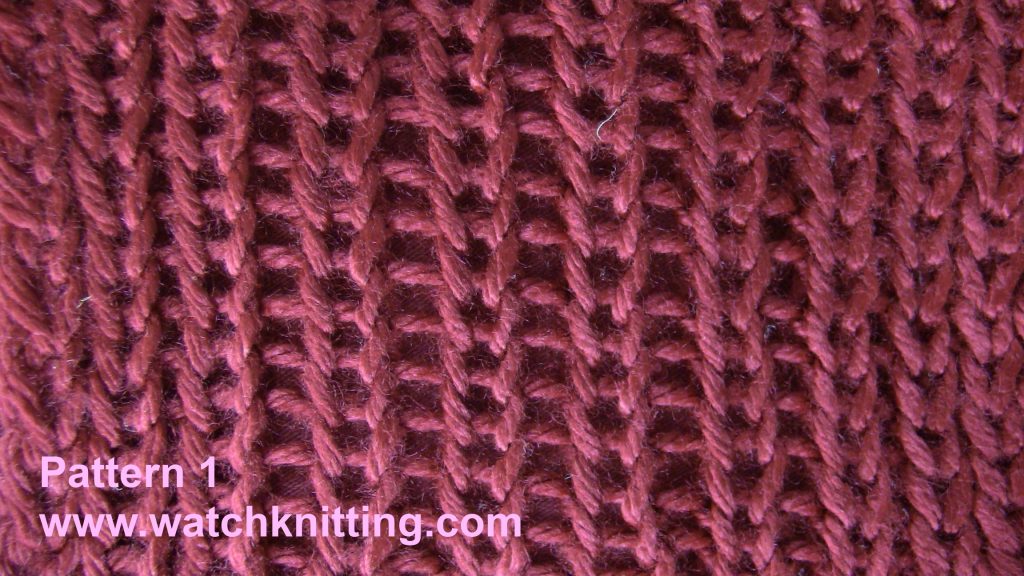
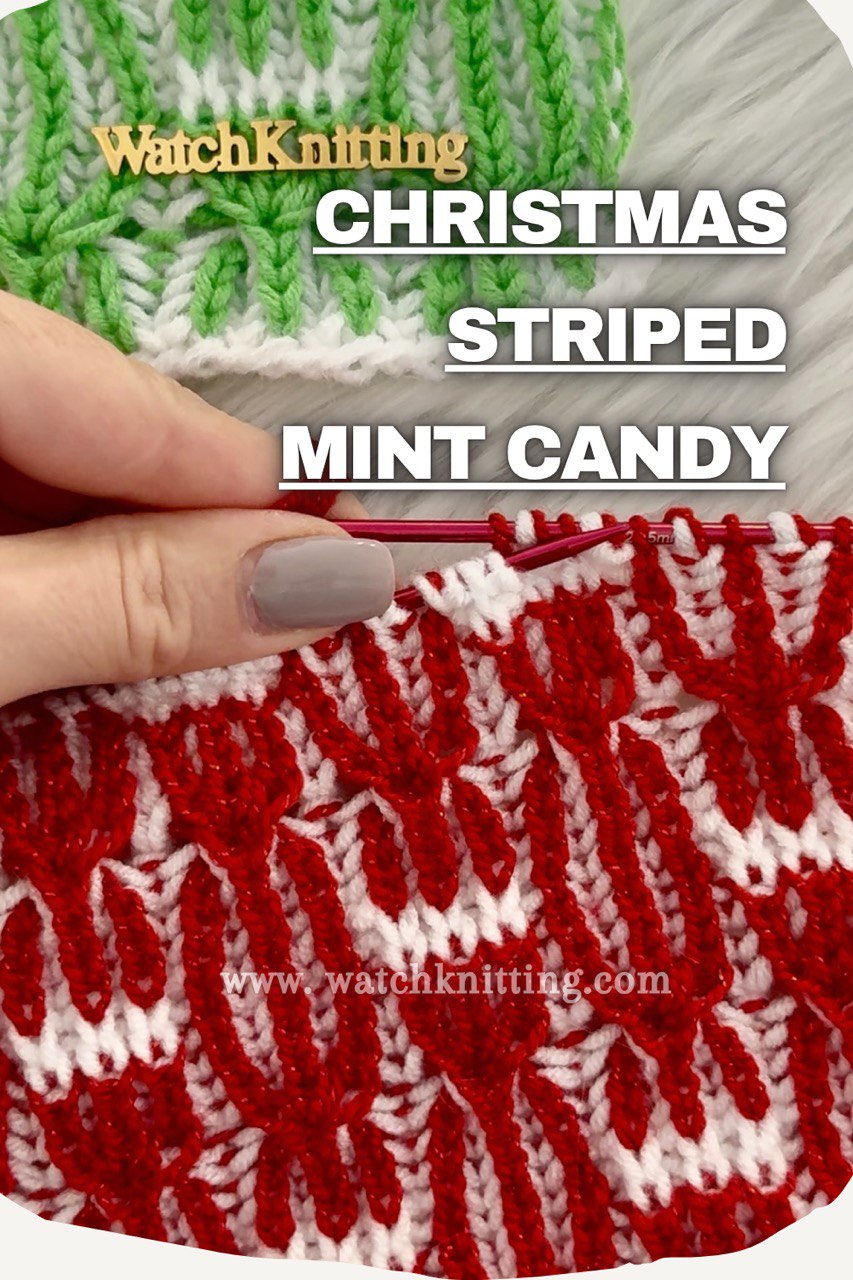
In this tutorial, I’m excited to show you my own brioche design, inspired by my original Candy Pattern.
The first Candy Pattern was worked a bit differently — using a single color and another technique. This new version is specially redesigned for Christmas, with red and white (or any two contrasting colors) to resemble those cute striped mint candies.
If you’d like to try the solid color version, that tutorial is already available. You can find the link here.
🧶 Materials
To knit this pattern, you’ll need:
- Two fine yarns in contrasting colors
- Double-pointed needles or a circular needle (you’ll need to switch colors every row, so straight needles won’t work)
- Cast on a multiple of 6 + 3 stitches
- This pattern has a 40-row repeat
The white will be the background color (BC), and the green (or red) will be the contrast color (CC).
🪡 Pattern Overview
We’ll be working a two-color brioche stitch, creating a beautifully raised texture that looks like rows of wrapped candies.
Don’t worry if you’re new to brioche — I’ll guide you step-by-step through each section.
You’ll start from the wrong side, setting up your brioche foundation, and then alternate between the background and contrast colors.
🔹 Brioche Basics
For this pattern:
- sl1yo = Slip 1 stitch with yarn over (yarn over, slip next stitch purlwise)
- K2tog / P2tog = Knit or purl 2 together
- C5dec-inc5 = Central candy shaping — a decrease over 5 stitches followed by an increase of 5
- BC: background color
- CC: contrast color
- RS: right side
- WS: wrong side
🔹 Tips
- Each time you switch colors, check your tail position to identify the right side (RS) and wrong side (WS) for that color. Each color is worked a knit row on its right side and a purl row on its wrong side
- The last stitch of the background row is always sl1yo (not knitted).
🧵 Pattern Instructions
Cast on: a multiple of 6 + 3 stitches with both needles using the background color (BC).
Work one setup row first, then alternate between BC and CC as follows.
40-Row Repeat
Set-up Row (BC–WS): edge, rep [K1, sl1yo]
Row 1 (K Row – CC–RS): edge, rep [sl1yo, K2tog], sl1yo, edge
Row 2 (P Row – BC–WS): edge, rep [P2tog, sl1yo]
Row 3 (P Row – CC–RS): edge, rep [sl1yo, P2tog], sl1yo, edge
Row 4 (K Row – BC–WS): edge, rep [K2tog, sl1yo]
Row 5 (K Row – CC–RS): same as Row 1
Row 6 (P Row – BC–WS): same as Row 2
Row 7 (P Row – CC–RS): same as Row 3
Row 8 (K Row – BC–WS): same as Row 4
Row 9 (P Row – CC–RS): edge, rep [sl1yo, C5dec-inc5], sl1yo, edge
Row 10 (P Row – BC–WS): edge, rep [P2tog, (sl1yo, P1)×2, sl1yo], P2tog, sl1yo
Row 11 (P Row – CC–RS): same as Row 3
Row 12 (K Row – BC–WS): same as Row 4
Row 13 (K Row – CC–RS): same as Row 1
Row 14 (P Row – BC–WS): same as Row 2
Row 15 (P Row – CC–RS): same as Row 3
Row 16 (K Row – BC–WS): same as Row 4
Row 17 (P Row – CC–RS): edge, rep [(sl1yo, K2tog)×3, sl6 wyib], (K2tog, sl1yo)×3, edge
Row 18 (P Row – BC–WS): edge, rep [(P2tog, sl1yo)×3, (P1, drop CC K1)×3, P1], (sl1yo, P2tog)×3, sl1yo
Row 19 (P Row – CC–RS): edge, rep [(sl1yo, P2tog)×3, sl7 wyif], (P2tog, sl1yo)×3, edge
Row 20 (P Row – BC–WS): edge, rep [(K2tog, sl1yo)×3, (K1, sl1yo)×3, K1], (sl1yo, K2tog)×3, sl1yo
Row 21 (K Row – CC–RS): same as Row 1
Row 22 (P Row – BC–WS): same as Row 2
Row 23 (P Row – CC–RS): same as Row 3
Row 24 (K Row – BC–WS): same as Row 4
Row 25 (K Row – CC–RS): same as Row 1
Row 26 (P Row – BC–WS): same as Row 2
Row 27 (P Row – CC–RS): same as Row 3
Row 28 (K Row – BC–WS): same as Row 4
Row 29 (P Row – CC–RS): edge, rep [sl1yo, C5dec-inc5, sl1yo], edge
Row 30 (P Row – BC–WS): edge, rep [P2tog, (sl1yo, P1)×2, sl1yo], P2tog, sl1yo
Row 31 (P Row – CC–RS): same as Row 3
Row 32 (K Row – BC–WS): same as Row 4
Row 33 (K Row – CC–RS): same as Row 1
Row 34 (P Row – BC–WS): same as Row 2
Row 35 (P Row – CC–RS): same as Row 3
Row 36 (K Row – BC–WS): same as Row 4
Row 37 (P Row – CC–RS): edge, rep [sl7 wyib, (sl1yo, K2tog)×3], sl7 wyib, edge
Row 38 (P Row – BC–WS): edge, rep [(P1, drop CC K1)×3, P1, (sl1yo, P2tog)×2, sl1yo], (P1, drop CC K1)×3, P1, sl1yo
Row 39 (P Row – CC–RS): edge, rep [sl7 wyif, (P2tog, sl1yo)×2, P2tog], sl7 wyif, edge
Row 40 (K Row – BC–WS): edge, rep [(K1, sl1yo)×3, K1, (sl1yo, K2tog)×2, sl1yo], (K1, sl1yo)×3, K1, sl1yo
✨ Pattern Notes
- The 40-row repeat builds the complete candy stripe sequence.
- To continue the pattern, simply repeat from Row 1.
- The C5dec-inc5 stitches create the candy shape with the signature twist and wrapped look.
- The fabric is not reversible.
📺 Watch the Tutorial
I hope you enjoy knitting this festive Candy Brioche pattern!
It’s a little tricky at first, but once you understand the rhythm, it becomes super fun and satisfying.
If you have any questions, drop them in the comments! I’ll do my best to help.
Happy knitting and have a wonderful day! 🎁🧶


Leave a Reply