

Hello friends! Fariba here from Watch Knitting.
In this post, I’m sharing a detailed comparison of four rib stitches that look similar but create very different textures: Shaker Stitch, Fisherman’s Rib, Half Fisherman’s Rib, and Brioche Stitch. All of these patterns use the knit-1-below (K1B) technique in one way or another, but the method and the final fabric can vary a lot.
Below, I’ll show you how each stitch is worked, what makes them unique, and how to tell them apart when choosing the best stitch for your project.
Why Compare These Four Rib Stitches?
These stitches are often confused with each other because they all create a deep, squishy rib. Many knitters use the names interchangeably — especially Brioche Stitch and Fisherman’s Rib — but they actually produce different textures when worked correctly.
In this tutorial, all swatches are made with the same yarn, same needle size, and same number of stitches so you can clearly see the difference in:
- Stretch
- Thickness
- Width
- Reversibility
- Shape of the knit columns
- Loop structure
1. Shaker Stitch
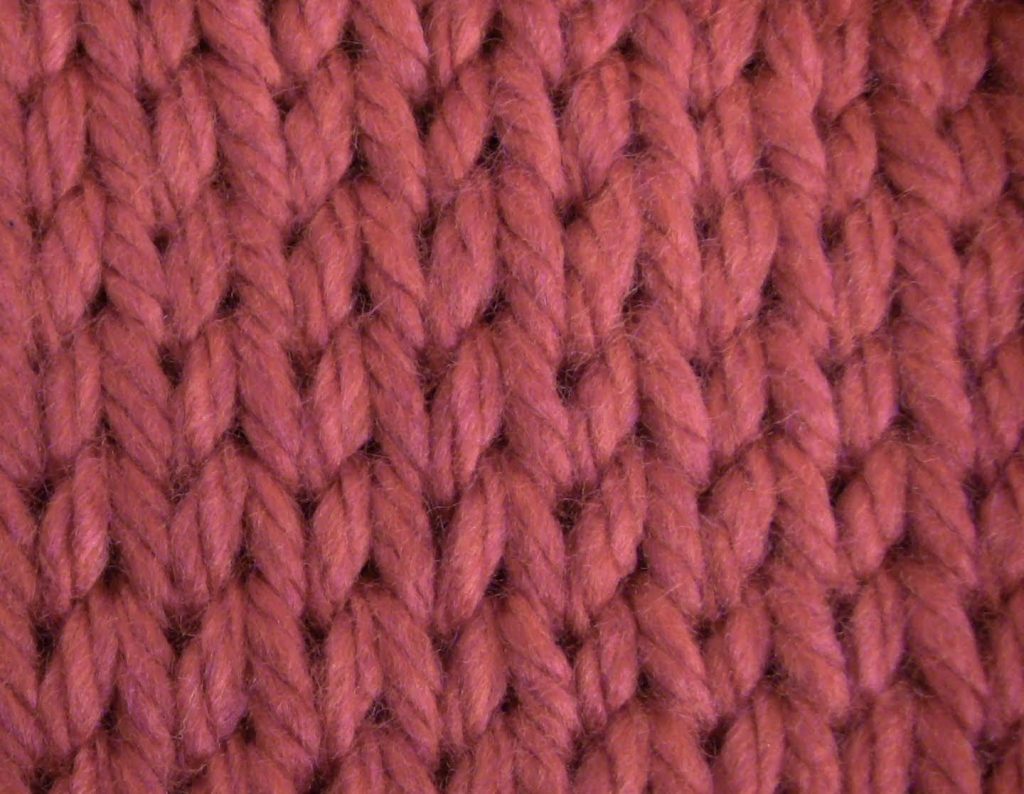
Shaker Stitch is the simplest and fullest version of the knit-1-below family. It produces a very thick, airy, and wide fabric.
Key Features
- Very large loops
- Extremely stretchy
- Reversible
- Fuller and wider than Fisherman’s Rib
- Uses simple K1B and purl stitches
Shaker Stitch Instruction
Cast on an odd number
Setup row: K1, P1
Row 1: edge, rep (K1B, P1), K1B, edge
Row 2: edge, rep (P1, K1B), P1, edge
How It’s Worked
- Cast on any odd number of stitches
- Work one setup row in simple 1×1 rib
- Then repeat one row (alternating whether you start with K1B or P1 depending on RS/WS)
The texture is deep, soft, and perfect for scarves and blankets.
2. Fisherman’s Rib
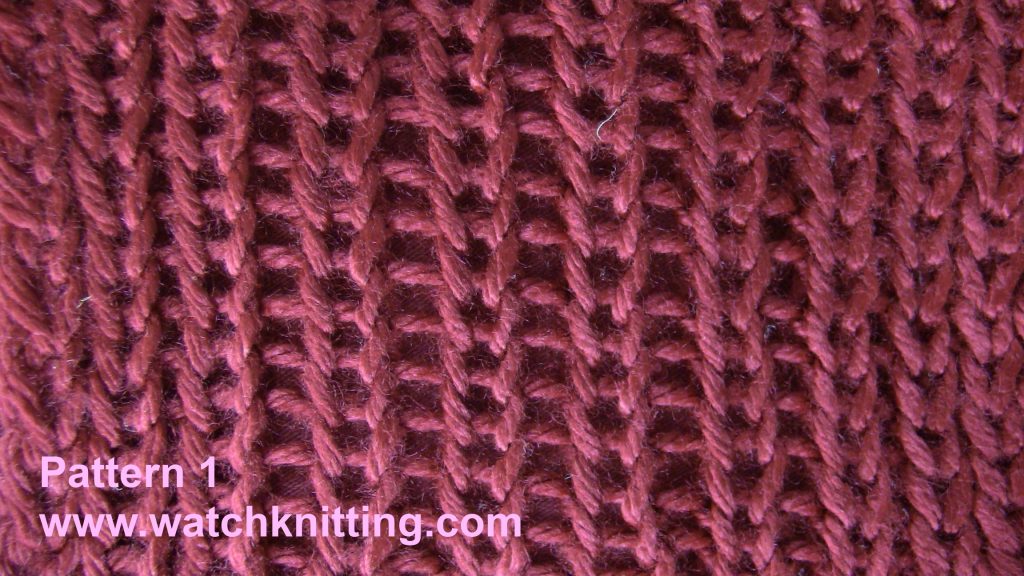
Fisherman’s Rib instructions looks similar to Shaker Stitch at first glance, but the method of grabbing the yarn makes a huge difference. The knit columns become more defined, and the knit cloumns show a subtle herringbone effect instead of a plain V-shape.
Key Features
- Reversible
- Dense, structured rib
- Knit columns appear twisted or braided
- More defined lines than Shaker Stitch
- Uses K1B but the yarn is wrapped differently (Reveres Wrap)
Fisherman’s Rib (Reverse-Wrapped Knit Below)
Cast on an odd number
Setup row: K1, P1
Row 1: edge, rep (RWK K1B, P1), RWK K1B, edge
Row 2: edge, rep (P1, RWK K1B), P1, edge
RWK: Reverse-Wrapped Knit
How It’s Worked
- One setup row in 1×1 rib
- RWK: Reverse-Wrapped Knit (In the pattern row, the knit-1-below is worked by bringing the yarn over the needle and pulling it up from the opposite direction)
- This change in yarn direction creates the signature herringbone look
The result is a beautiful, tighter rib that holds its shape better than Shaker Stitch.
3. Half Fisherman’s Rib
Half Fisherman’s Rib is a non-reversible variation that alternates between a knit row and a Fisherman’s Rib row.
Key Features
- Not reversible
- Much narrower than the other two
- Flatter and less stretchy
- Combines regular knitting with K1b
Half Fisherman’s Rib
Cast on an odd number
Row 1: K
Row 2: edge, rep (P1, RWK K1B), P1, edge
RWK: Reverse-Wrapped Knit
How It’s Worked
- No setup row
- Row 1: Knit all stitches
- Row 2: K1B (RWK) + regular purls
- Repeat Rows 1 and 2
Because only one side uses knit-1-below, the texture is more subtle and the fabric lies flatter.
Abbreviation Guide:
| RWK – Reverse-Wrapped Knit A knit stitch worked by wrapping the yarn in the opposite direction before pulling it through the stitch. This reverse wrapping changes the orientation of the stitch and creates a distinct texture, often used in Fisherman’s Rib and Half Fisherman’s Rib. How to Work RWK Insert the right needle into the stitch as if to knit. Wrap the yarn clockwise (reverse of normal). Pull the new loop through to complete the knit stitch. Continue with the next stitch as instructed. K1B – Knit One Below A technique where you knit into the stitch one row below the stitch currently on the needle. This creates a deeper, fuller knit column and is commonly used in Shaker Stitch, Fisherman’s Rib, Half Fisherman’s Rib, and Brioche-style textures. How to Work K1B Insert the right needle into the center of the stitch below the one on the left needle. Wrap the yarn as usual. Pull the new loop up through that lower stitch. Slip the upper stitch off the needle as if it were worked. |
4. Brioche Stitch
Brioche is often mistaken for Fisherman’s Rib because it creates a similar deep, fluffy rib. But the method is completely different.
Key Features
- Uses yarn overs
- Reversible
- Extremely squishy and stretchy
- Knit stitches form full V shapes
- Depth comes from slipped stitches + yarn overs, not K1B
How It’s Worked
- Brioche is worked with yarn overs and slipped stitches, not knit-1-below
- The resulting fabric is airy and very elastic
- The knit stitches look more “open” and less twisted than in Fisherman’s Rib
If you compare Fisherman’s Rib and Brioche side by side, you’ll notice that the knit stitches in Brioche are complete V-shapes, while Fisherman’s Rib has a more braided look.
How to Tell the Stitches Apart
✔ Shaker Stitch
- Large loops
- Full, fluffy rib
- Simple K1B
- Very wide and reversible
✔ Fisherman’s Rib
- More defined, herringbone-like knit columns
- Tighter than Shaker
- Reversible
- Still uses K1B, but yarn is wrapped differently
✔ Half Fisherman’s Rib
- Only one side worked with K1B
- Not reversible
- Flatter and less stretchy
✔ Brioche Stitch
- Worked with yarn overs
- Deep rib
- Extremely stretchy
- Open V-shaped knits
Which One Should You Choose?
| Stitch | Best For | Texture | Stretch | Reversible |
|---|---|---|---|---|
| Shaker Stitch | Scarves, blankets | Very full | High | Yes |
| Fisherman’s Rib | Sweaters, hats | Defined, structured | High | Yes |
| Half Fisherman’s | Pullovers, fitted garments | Flat, neat | Medium | No |
| Brioche | Shawls, scarves, hats | Deep, airy | Very high | Yes |
Conclusion
These four rib stitches may look similar, but each offers a unique structure and feel. Whether you want airy fullness, defined rib lines, or a deep brioche texture, understanding the differences helps you choose the perfect stitch for your project.
If you have any questions, feel free to leave a comment.
Happy knitting! 💛🧶




Leave a Reply